How the NHS failed me and mine.
What it did, to the most important person
in my life and how it could happen to you unless
we do something about it!
Powered By Blogger
Showing posts with label Consultant. Show all posts

Monday, 30 April 2012

The Constant Patient

Loss of Innocence-It Goes On.

I left the saga last with J' having gained control of her Diabetes and progressing to a more 'normal' lifestyle, but of course once the NHS has it's claws into you it never wants to let go. Between us we decided that we did not want to participate in any of their 'educashun' (sic) programmes for Diabetes, nor did we want to return to that hospital for any tests for osteoporosis, or X-rays or indeed for anything. Whilst both of us had a jaundiced view about DXA scans for bone density, on balance we thought it was justifiable to have at least one done to determine whether any such condition really existed. As a consequence we decided to pay for one at another location. So we did.

The results were pretty much as predicted; her hip and spine were slightly less dense than optimal and she was defined as 'osteopenic', which is pretty much what any post-menopausal woman is likely to be, especially in our Vitamin D deprived country with it's aversion to sunlight, love of sunscreens and paranoia about cholesterol. All these, for those who do not know, contribute to the density of the human skeletal structure or rather don't, if you employ any of the above.

A year down the line from the accident we also saw a 'new' Consultant who X-rayed the hip in which the prosthetic 'lurked' to ascertain the extent of any acetebular erosion or protrusion. There wasn't any; well not that could be seen, but frankly a normal X-ray is unlikely to show any until progression was reasonably advanced. It did provide some assurance however and the Consultant was at least honest and didn't treat either of us like children, probably because I talked the 'language' of his profession, in that I utilised medical terminology. In the meantime, we had both changed to a new (for us) GP practise. Because J' was now a registered Diabetic she then began to receive constant entreaties both in the mail and on the 'phone to attend for this test, that vaccination, sundry assessments most of which were largely pointless, or were largely encompassed by our own protocols.


Out of interest, we eventually gave in to a 'diabetic assessment' more out of curiosity than anything else. Of course it was undertaken by a Diabetic Nurse, which presumably did not describe her condition (it was a woman) but her vocation. Looking as she did I was prepared to revise that view because she embodied the 'don't do as I do, but as I say', philosophy in the NHS of appointing those who look sicker than their patients to advise them of the error of their ways. She looked as if she had been a Diabetic herself for many years, bordering on obese, with a florid face and that constant frown, common in those that have little understanding of  what they are doing because they have no idea of why they were doing it,  (I think she probably drowned puppies for a hobby).

She took J's blood pressure (132/65), weighed her, which was the same as it always was (now) took some  bloods for analysis including for a 25(OHD) that I had requested and laid her on the couch and prodded her feet with a short bristle device. As she weighs herself weekly, I take her blood pressure, and often 'tickle' her feet (it makes her jump) it all seemed pretty pointless to be frank, but she did suggest we come along to the 'club' they have for Diabetics, and also a training session where we would have likely had the virtues of low calorie/low fat dieting, extolled in glowing terms and of course be told that there was no need to 'test' constantly (because test strips cost money and the NHS doesn't have any). We declined I'm afraid. She looked crestfallen at this news, but we had seen the pictures on the leaflet and certainly did not want to emulate any of the antics therein portrayed (watching paint dry seemed more attractive).We left then to await the blood test results which were to be available in about 5 days.

Four days later, whilst we were whiling away the time at the 'hovel' counting the cobwebs on the ceiling, the 'phone rang and lo' it was the lead partner in the GP practise wanting to speak with J' about the test results. As we did not have them as yet I found this curious, but not wanting to prejudge the situation, I put her on the 'phone and listened in on the speaker. After praising J's HbA1c result, of 6.3% (the achievement of which he had no hand in, but would be rewarded anyway on the Quality Outcomes Framework) he raised the question of her Cholesterol level of  7mmo/L and suggested she take a statin. J' then asked me to respond to this so I took over the conversation after she gave permission to the Doc' on the 'phone. I pointed out to him that there was no evidence to support such a protocol for any woman, and that it would likely be injurious to her health, along with a few choice references that supported my view, and perhaps he might do a bit more research? At that point he fell back on the "I am only carrying out orders" defence and then told me how the QOF meant he had to do things that he did not always agree with, just to earn a 'crust'. Forcing back a tear, I expressed my heartfelt regret at such appalling treatment meted out by the PCT Commissars and we left it at that, after he promised to let me have a copy of all the test results.

What then are we to make of this? Well, GP's are paid to monitor Diabetics under the QOF protocols and ours had earned 44 points by undertaking the Diabetes examination and recording the findings. This includes achievement of some points from blood pressure, HbA1c and certain levels in the blood of various components, all of which he had no hand in at all! But of course that is never enough. We already had refused the tests for Retinopathy, because our Optician included it in J's annual eye test, the annual flu' vaccination, because it's counterproductive and now of course we had refused statins'. One gets the idea that curing sick people is merely an adjunct to the more important task of fulfilling certain criteria within QOF that invoke payments. Is this what Primary Care has become? Well err... yes.

Diabetics are treated very poorly by the NHS, and outcomes continue to worsen, mainly I believe because the diets, drugs and lifestyle advice is founded upon poor science, dogma and the touching (but wrong) view that 'Pharma' is a benevolent edifice, searching endlessly for cures and life enhancing drugs to make the lot of Diabetics as 'normal' as possible.The truth is that they only want to 'treat' the condition and symptoms with a cocktail of their products, in ever increasing number and volume to make a profit! Virtually all of the evidence that backs their products as efficacious is funded by them. Diabetes UK is heavily dependent on their largess as is the US equivalent the ADA.

It is not inevitable that Diabetes is progressive and life shortening unless the 'mainstream' treatments are pursued. Many know this and either overtly or covertly follow their own agenda and are considerably healthier as a result. When J' gets a day when her three times a day tests, all come out as normoglycemic purely by gist of diet, a little exercise and a few supplements, it is a cause for celebration. It can be difficult some days, there are pitfalls in many foodstuffs that are not evident at first analysis but by testing rigorously they are soon found. But if you are not taking a hypoglycemic drug they are not funded by the NHS. So you have to buy them yourself. So you save the NHS lots of money by being responsible for your Diabetic destiny and the mealy mouthed idiots then penalise you for so doing. Crock of s**t or what?

I will continue to post the continuing saga as and when it happens. J' is somewhat handicapped as a Diabetic because her piss poor prosthesis is not conducive to vigorous exercise and that is a useful protocol for any diabetic to lower insulin resistance and 'burn off' excess glucose. So she has been doubly damned by the arrogance and stupidity of a system that is incapable of factoring in individual needs in treatment. Thank you NHS for making sure the law of unintended consequences rules!


Wednesday, 14 March 2012

Loss of Innocence (Part 3 -Aftermath)

As I drove away from the Hospital that Friday afternoon I felt euphoric, in that I had repatriated the women I loved from what seemed to me a prison. But I realised almost immediately that some practical and needed changes to our lives would be needed, at least in the short term. What was running through my head, were the words J' had related to me from the physio' she had seen on the third day of her ordeal, that "you know you will have to come back in about five years for a revision, when that wears out".  Had she heard right? But surely no-one in her position (the physio) would make such a statement without there being some truth behind it?

The Hospital had provided us with crutches, on loan, but they would be an encumbrance in our small and somewhat over furnished flat. I had then purchased a folding 'zimmer' frame for J' to use in the flat, especially if she was alone. I had also bought a bath seat to enable bathing, which in the short term had not to include much in the way of immersion of the wound. But the first things she yearned for had to addressed. A long awaited visit to the toilet, a decent meal, a good night's sleep and of course, her legs shaved, as she felt like a 'yeti' from the knees down!

Chanting the phrase, 'good to heaven, bad to hell' (which leg, in which order first) she got up the one flight of stairs, with my help. From that day on with me behind going up, in front going down. I do it to this day, although it's importance has waned. Having got her in the flat I padlocked the wheelchair to the banister outside, to ensure it's presence the following day, because there was too little space inside. In fact I removed all extraneous 'trip' spots and paraphernalia from the flat to mitigate the chance of a fall. I then began the process of turning myself into a carer and nurse. In many ways I found it easy; she was so precious to me I did not care about the commitment, or the attention to her intimate needs that were to be thrust upon me. In some ways I welcomed it; she deserved my undivided attention. She had loved and supported me for years and whilst I had always reciprocated, I had without doubt been selfish on many occasions and taken her for granted. I had stood back from myself during those days when I felt such loss and impending doom, and made a pact with her that whatever may become of the future, it would be one where her well being was predominant and not mine, as I felt it had been the opposite for too many years.

And so it began. I bathed her carefully, whilst she sat on the new bath seat. I shaved her legs and she took a mild laxative to reintroduce the process of peristalsis that had been lacking for a week. I got her an extra pillow so as to enable her to be more comfortable and then we had supper; a Chinese meal that she had longed for. Little did I realise, that by pandering to her desire, I was compounding the errors made by the Hospital and pushing her blood glucose through the roof. However that was to be for the future.

It was a blissful weekend in many ways. We went out of town on the Saturday and had a quite lovely meal, with me pushing her into the restaurant in her wheelchair and then helping her into a normal chair, realising as I did it, the problems disabled people had to endure to gain access to so many places. I was to find this irksome after a short while and thus became a harsh critic of establishments that failed to take account of the needs of wheelchair users to enjoy simple pleasures without the need for a small team of weight lifters in accompaniment. How blind we all are to others, when it does not impinge upon our lives. But this bliss was tinged with some sadness. I hoped that J' would be able to walk quite soon, hoped her recovery would be rapid but I also realised that it would be a long hard road and it was likely that she would never be able to ride a horse or a bicycle, partly because the consequence of a fall, with a big metal ball on a stem instead of her greater trochanter, would be too greater risk for me to let her. She had been doing both since she was twelve, and generally viewed horses as superior to humans', most of the time. Then I had to face the problem of my work whilst fulfilling the needs of her carer. It would be a long time in the future when I could leave her alone without a pounding heart.

And so I reached a compromise, at least for the next six weeks before her post-op appraisal. I worked in the mornings and came home in the afternoon to feed her, help with physio exercises and take her out to enjoy what was left of summer. I worked mostly in fear, not really giving it the attention that I should. Ridding myself of the myriad tasks that I had micromanaged before, because my ego would not allow me to delegate to others. I was the only one capable I had always thought, and I lacked the confidence to allow others to fulfil my many roles. But now, I no longer cared about the pursuit of clients or wealth, I just wanted to make her whole again, whatever the cost. It turned out to be high, but I don't think I would have done it differently, even given another chance. Then again all of us often feel that if we needed to start over we wouldn't want to start from here, but we cannot turn back time although on occasions in the next few months, I would often wake up and think it was just a bad dream and I would look to my left and see the J' I used to know, not the one I now had, who always looked as if pain was her only emotion.

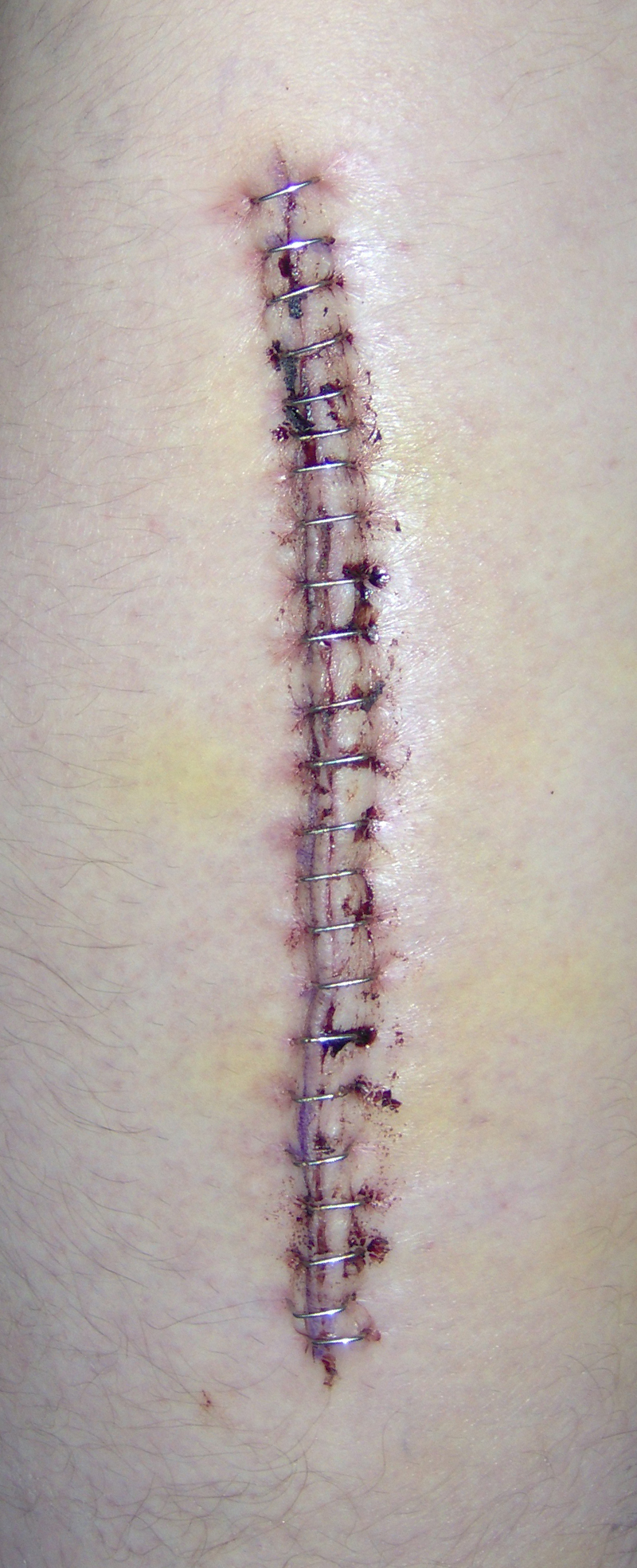
We got her stitches removed on the next Monday. late it seems because those damn paper clips that pass for sutures today could hardly be called 'stitches', should have been done at day five apparently as the flesh had started to 'grow' over them. I winced for her as they were dragged from her flesh by the GP Nurse. She re-dressed the wound which was healing well, but still resembled a long, red 'slash' in her thigh. I kept thinking why did it all have to be so disorganised, why was there not some sort of 'plan'  for the aftercare of hospital patients? Then I remembered there had been little in the way of plan right at the start. Maybe someone had written it down on the back of a 'fag 'packet somewhere, and then lost it; well that's how it seemed. Everything had the appearance that it was left to 'kismet', rather than any sense of order or commitment to the patients well being.

We took to walking along canal towpaths; they are always flat, except for the locks, and locally there weren't many at all. She would walk with crutches and after some practise, and a little coaching in co-ordination, she became adept. As soon as she tired I would put her in the wheelchair and  return from whence we came, back to the little red van. The wheelchair was the 'backstop', the means of letting her learn to walk again, without any risk of not being able to return. Soon she was able to walk with just the one, and one day in late July when I had pushed the chair into the town, as we often did, I purchased for her a 'glamorous' walking cane; all glitter in the handle and a shimmering green on the shaft. After that she cast aside the crutches, and the memory of whence they came; well not quite.

She had been traumatised by what had occurred,to the extent that I could not get her to open up to me about the events to which I was not witness; the pre-op phase, the morning of the operation, the conversations she may (or may not) have had with the Consultant, whom I found out was an expert in, err... hands! It was frustrating, I even got angry a few times, but I realised the depth of harm she had suffered and gave up quite quickly, realising that it was too soon, and that it may never be the right time or perhaps she found it so bad as to have erased it completely.

Eventually the days and hours passed and we came to that moment she hoped for, the day she saw the Consultant. Her main concern being that she could drive once more and return to work. I hoped that he would not allow it, but she put on a 'show'. Still believing, I am sorry to say that this man 'knew what he was doing', and that she wanted to be back where she used to be, and that he would give her license to be so. After ages of waiting we were shown to a cubicle, in the clinic. We sat there for what seemed a long time, me working myself up to a level of stress I had only felt when I was waiting to see if my second child would live, shortly after birth. J' on tenterhooks to see if he would 'sign her off sickness'. Then the great man arrived; all rugby club tie, shiny tan brogues and Oxford striped shirt. What a pr**k he was. Taken aback by my request to see the X-ray, he blustered his way through precisely five minutes, of explanation of what J' should do, which comprised mainly of walking to exercise the leg, but not to bother with any physiotherapy; it wasn't needed. Just "walk up and down for me please, oh that's fine. Any problems go and see the GP". I was still looking at the X-ray and before I could say anything, he was gone!

I had been confused. The image did not compute with that which I expected. Although I had believed J' to have had a hemiarthroplasty, the image showed something that to my untrained eye looked like a total hip arthroplasty. I wanted to quiz the Consultant, but he had already moved on to his next patient; it was the 'little old lady' we had sat next to in the waiting area, and guess what was on the screen at the end of the cubicle? That's right, that same image I had just seen. Even more confusion, or perhaps they just put up the same image for all the screens in the Fracture Clinic, with hip replacements. At that juncture, it would not have surprised me at all.

We left, J' clutching her discharge note, signing her as 'fit to work' together with a letter for the GP (sealed) and me clutching her hand, in a welter of anger, confusion and in need of strong drink. I felt patronised, sidelined and deeply suspicious of the only answer I had gleaned from this Consultant, who seems not to have to consulted in any way with the person(s) with whom he needed, and in answer to the question of "how long will this prosthesis last?", he said, with a straight face, "forever". J' was pleased she had been allowed to drive again and could return to work, which frankly filled me with dread.

She was I realised, simply shutting everything out that she did not wish to face. The events had closed down her usual scepticism and the questioning of matters that she usually displayed, and in it's place was an an almost subservient trusting attitude. It was as if the NHS and Consultants would not undertake any procedure that was likely to provide an outcome that was less than good for a patient. In the coming months that was to change. Change completely, once she found out what they had done, why, and more importantly, what they had forgotten to do. And what they had forgotten was going to impinge upon her life, for all of her life.

Again, dear reader, I crave your indulgence. This story has to be episodic and the 'aftermath' continues again shortly. It is called 'the complaint'.